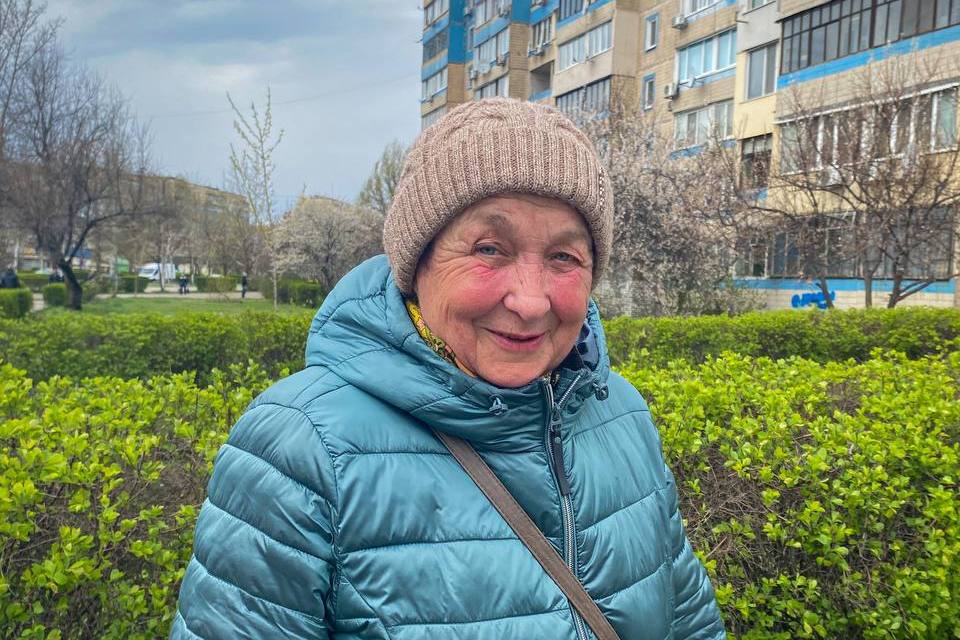
35 years ago, in 1991, Ukraine became an independent country. Since then, older people in Ukraine have lived through profound change. They have raised families, built careers, retired, cared for loved ones, experienced loss and adapted to new realities. For many, war has also brought displacement and separation from home.
Yet through all these changes, many have held on to the things that matter most: their families, their communities, their sense of purpose and their hope for a peaceful future.
For Ukraine’s 35th Independence Day, HelpAge International asked older people to reflect on three questions: What has changed over the past 35 years? What has stayed the same? And what do you hope Ukraine will look like in the next 35 years?
Their answers are more than memories. They are stories of a generation that has lived through Ukraine’s independence – and continues to shape its future.
“I have spent my whole life trying to help people, and I continue to do so today.”
Liudmyla is 84 and has lived in Lviv for more than half of her life. Thirty-five years ago, she was 49 and, as she describes it, “in the prime of my life”.
In 1991, she worked as a trade union leader, supporting workers on social issues, health and wellbeing, and employment rights. At home, her eldest son had recently married and she and her husband were waiting for their first grandchild.
There were friends, community groups and clubs. Life was busy and full of possibility.
When Ukraine declared independence in 1991, Liudmyla was visiting her parents in Russia.
“It was frightening and worrying because a coup had just begun in Russia. We were not even sure whether we would be able to get home to Ukraine.”
The difficult 1990s followed, but Liudmyla says she continued to believe in Ukraine’s future.
We always believed that Ukraine would become a prosperous country. It has beautiful nature, many resources and hardworking people.
Over the next 35 years, much changed. Liudmyla became a grandmother to four grandchildren. She worked until she was 67 and eventually retired. She also lost her husband, just months before their 60th wedding anniversary.
She remembers their final years together with particular warmth.
“We became even closer than we had been when we were young. We were both retired, the children had grown up, and we had time for each other. We walked hand in hand, read, went for walks and dreamed about building a dacha where our children and grandchildren could gather.”
Today, Liudmyla continues to support people around her. She helps an older neighbour whose adult son has a disability, bringing food from her garden, baked goods and clothes.
“All my life I have tried to help people, and I continue to do so today.”
Her own hopes are shaped by the war.
“I dream that missiles will stop flying over Ukrainian cities, that people will stop dying and that every human life will be respected and protected.”
And when she thinks about the next 35 years, she imagines a country rebuilt in peace:
I want Ukraine to recover and rise from the ruins of this senseless war. I want our fertile black soil to continue feeding not only Ukraine, but half the world. I want peaceful skies over our country again.
“The desire to live!”
Tetiana is 65. Thirty-five years ago, she lived in Sievierodonetsk and worked as an economist at an industrial enterprise.Her dreams were simple: financial security, travel and good health.
At the time, she says, she rarely thought about what Ukraine meant to her.
“I just lived my life and never really thought about it, until the war began in 2014.”
Today, Tetiana has been displaced twice and lives in Kharkiv. Her life has changed dramatically. During the war, she suffered a blast injury, underwent a long recovery and lost her sight, which she was only partially able to regain.
When asked what has remained unchanged over the past 35 years, her answer is simple:
“The desire to live! And I want to live here, in Ukraine. I was invited to Germany, but somehow I feel more at peace at home.”
Thirty-five years ago, Tetiana dreamed of travelling. Today, she dreams of peace and good health.
For the next 35 years, she wants to see Ukraine become a stronger and more developed country – one where older people can live with dignity and access the healthcare they need.
I really want people’s incomes to improve, for older people to be provided for with dignity, and for healthcare to be genuinely accessible. I believe Ukraine will become a developed and strong state. We are capable of this.
“Times were hard, but Ukraine was not weak”
Liubov is 82 and comes from the Kharkiv region. She worked as a milkmaid throughout her working life.
“I started after school at the age of 17, and I worked with cows and calves all my life.”
Thirty-five years ago, she says, she was focused on work and raising her children.
I never really had time to think about what kind of Ukraine I wanted to see. I had to work and raise my children. Times were hard, but Ukraine was not weak. Thirty-five years of independence is not very long. I would like Ukraine to always remain independent.
Today, Liubov lives in a dormitory in Kharkiv after being evacuated from the village.
The war has changed her life more than anything else.
“The war happened. That is what changed my life the most.”
Yet her love for Ukraine and her native land remains unchanged.
“I want to return home and see my friends in the village. I dream that I will still be able to work in my garden.”
Her hopes for the next 35 years are rooted in peace and dignity:
“First and foremost, we need peace. With peace will come a higher standard of living and better pensions. I would like the state not to forget about older people.”
For Liubov, returning home is about much more than a place. It is about reconnecting with her community and the life she had before the war.
“I believe the war will end soon, and Ukraine will recover”
Vasyl was born inthe city of Snizhnein the Donetsk region and worked there all his life as a taxi driver. Today he is 72 and has lived in Petrykivka in the Dnipropetrovsk region since 2014, when the armed conflict began in eastern Ukraine.
Vasyl considers his children his greatest achievement of the past 35 years. He says they inherited his remarkable ability to memorise and learn foreign languages.
“My daughter lives in Cambridge, in the United Kingdom, my granddaughter studies at a local university, and my son lives and works in Ukraine for a Swiss company. He speaks English, German and French.”
Another thing that has remained unchanged is Vasyl’s love of literature and languages. Even today, he can spend hours quoting writers, including reciting from memory descriptions of the Ukrainian steppe by Mykola Gogol.
The greatest challenge of his later life was the radical change brought by war after he turned 60. He lost his home and the life he had known.
Today, he tries to focus on the present and appreciate the small things that still bring him joy.
I try not to think about illnesses and troubles, but to enjoy the little things - the flowers in the garden, the opportunity to go to the river with my wife, simply being together.
I am an optimist and a lover of life. I believe the war will end soon, Ukraine will recover, and we will return home.
Vasyl, 35 years ago
His story is also a reminder that displacement and loss do not erase a person’s interests, talents or sense of identity.
“I want my children and grandchildren not to be afraid of tomorrow”
Viktoriia is 60 and spent most of her life in Kramatorsk – the city connected to her home, family, friends and memories.
Thirty-five years ago, she says, both she and Ukraine were just beginning a new chapter.
“I was young, I worked at a machine-building enterprise and started a family. At the time, I could not imagine how much would happen over those years. It seemed there was a whole life ahead.”
During those years, her children grew up, grandchildren were born and the country changed.
Then the war forced Viktoriia to leave her home and start again in Dnipro.
A lot has changed over these 35 years: the country, cities, technologies and the way people live. Children have grown up, grandchildren have been born, there have been joyful events and difficult times. The hardest thing was realising that the place you had called home for so many years was now far away. But I told myself: the main thing is that we are alive. And that means we have to keep living.
The experience of displacement also changed what home means to her.
“I used to think that home was a flat, a street, a city. Now I understand that home is, above all, the people who are around you, the people you love.”
Her hopes for the next 35 years are centred on the next generation.
“I want my children and grandchildren to live in a peaceful country. I don’t want them to have to experience what our generation has experienced. I want them to be able to make plans, work, travel and simply not be afraid of what tomorrow will bring.”
For Viktoriia, rebuilding is not only about restoring homes and cities. It is about restoring the possibility of an ordinary future.
“Memory is not just about remembering, it is our responsibility”
Raisa is 67. She belongs to a generation that remembers how the country changed not from textbooks, but through her own life.
Her school years, education, first job and professional life all took place in the Dnipropetrovsk region. When Ukraine became independent, Raisa was leading the “Svitanok” House of Household Services – work centred on people, their everyday needs and their trust.
She remembers those years warmly:
“We held on to each other. There wasn’t much, but there was sincerity.”
Ukraine’s independence brought hope for a new beginning.
“It seemed that only light and peace lay ahead.”
But the country, like the lives of its people, went through change, crises, development and loss.
Today, Raisa leads the public organisation “Union of Chernobyl of Ukraine”. She supports people with disabilities and people affected by the Chornobyl disaster and organises meetings and round tables with government representatives.
For her, this work is about more than professional responsibility.
“Memory is not just about remembering, it is our responsibility.”
The war has been the greatest challenge. Fear and uncertainty grew in 2014, and since 2022, war has become a daily reality.
War is when you are afraid not only for yourself. It is when you are afraid for everyone at once.
War does not only destroy homes - it tests people’s souls.
Raisa, 35 years ago
Raisa is particularly concerned about young people leaving and villages becoming emptier. She knows what land, work and community mean – and how closely they are connected to the future of a country.
Despite everything, her faith remains.
“I really want the war to end.”
She dreams of a peaceful Ukraine, of mornings without air raid alerts, villages coming back to life, children growing up without fear, and land once again giving people a livelihood.
Her hopes speak to a wider generation – people who have lived through Ukraine’s 35-year journey with its changes, losses, resilience and hope.
“As long as there are people like this – there is Ukraine.”
Lives shaped by change
These stories offer a glimpse of what 35 years of independence have meant in people’s lives: change, loss, new beginnings and enduring hopes for the future.
Older people have lived Ukraine’s history. They continue to shape its future.
The deaths of 34 care home residents in the Kyiv region starkly illustrate the particular risks faced by older people and people with disabilities during the war.
Intensified Russian attacks across Ukraine have again exposed the challenges many older people face in reaching safety during air raids. HelpAge is calling for more accessible and inclusive protection measures and humanitarian assistance.
Our latest report shows that older Ukrainians are being pushed further into poverty and despair as the war drags on. Their needs grow each year, yet too often they are invisible when help is given out.
Ukrainian filmmaker Adelina Borets reflects on her trilogy of films capturing the resilience, strength, and overlooked experiences of older people in Ukraine amid war.
Interim Country Director for HelpAge International in Ukraine tells her story and reflects on the resilience of older generation after two years of war.
70-year-old Lyudmila is a social care worker in eastern Ukraine. In addition to talking about her own experience, she echoes the thoughts of the people she has worked with.
Alena Karimova, 41, is a HelpAge social worker, based in Lviv in western Ukraine. She regularly visits and supports 18 older people, evacuated from the East because of the war.
She talks about how hard life is for everyone in Ukraine because of the cold winter weather and lack of power and electricity, caused by Russian attacks against energy infrastructure.
As the war continues, HelpAge International's country director in Ukraine Akbar Nazriev shares his insights on how things have changed and what life is like living under the ongoing threat of attack.
HelpAge International's Ukraine Humanitarian Response Manager, Orla Murphy, reflects on the past six months of full-scale war in Ukraine and the plans ahead to respond to the longer-term needs of those embroiled in a protracted war.
People have flocked to the city of Dnipro from all over eastern Ukraine, fleeing the war with Russia. Many are older people, who find themselves displaced in a strange city yet still responsible for the care of their loved ones. Here are their stories.
It's taken a while to process my visit to Moldova where I saw the humanitarian response to support Ukrainian refugees, some of whom I had the privilege to meet.
Everyone living in Ukraine has felt the impact of this war, but in a country where one in four people is over 60, the impact on older persons, including those with disabilities, has been dramatic.
Millions of older people caught up in the war in Ukraine are being overlooked in the humanitarian response, despite making up a quarter of the country's population.
Witnessing the impact of a humanitarian disaster is always profoundly challenging. But seeing so many older people affected in what is the world's 'oldest' crisis is particularly confronting.
June 4 marks 100 days since the start of full-scale war in Ukraine. For those in eastern Ukraine, February 24 was an escalation of a conflict they have endured for eight years. But, since then, we have seen the lives of everyone across the country changed beyond recognition.
Since the start of the Russian invasion of Ukraine, more than three million people have passed through Lviv, a city in the west where the borders of five neighbouring countries converge. Most travel further into Europe becoming refugees, but the city and its surroundings has taken in around 500,000 internally displaced persons (IDPs) since the start of the conflict, according to official data, and there are probably even more.
It is impossible not to notice signs of Moldovan solidarity with Ukraine. One such story is that of Argentina, 45, who is the manager of Zarea Hotel in the centre of Chisinau.
When the war in Ukraine began, Moldova, a small country nestled between Ukraine and Romania and Europe's poorest nation, initially thought it could accommodate 15,000 refugees. To nearly everyone's surprise, it received nearly 27 times that number.
Women and children have always been victims of war and Ukraine's conflict is no different. Yet the faces are markedly older in this crisis: 25% of Ukrainians are aged 60 or over, making this the world's 'oldest' war.
In response to the warning for all civilians in eastern Ukraine to evacuate the area, HelpAge International's CEO Justin Derbyshire outlined a more complicated picture.
HelpAge International is one of a handful of INGOs that has operated in the country since 2014, working with a network of partners and volunteers to support almost 5,000 older people living near the contact line between government and non-government-controlled areas.
Thousands of refugees are crossing the border from Ukraine into Moldova every day, fleeing the dangers of the Russian invasion. HelpAge International is building up its humanitarian presence in Moldova - where it has been working since 2000 - to help as many of those arriving as possible. Samuel Wood, Head of Humanitarian at HelpAge, visited the border and shared his observations.
Older people living in sub-zero conditions and heavily shelled areas of Eastern Ukraine desperately need food, clean drinking water and medication, according to a survey released today.
HelpAge International staff and volunteers in Ukraine are trying to ensure safety of their loved ones, and support older people, as the Russian invasion continues. Read their experience.
Tatiana Sorocan, HelpAge International Country Director in Moldova, travelled with colleagues to visit one of the many refugee centres in Moldova that have sprung up overnight.