 I have been called forgetful by friends many times before. Examples of this include finishing food and cups of coffee when they weren’t even mine! I didn’t think too much about this until I learnt about dementia.
Dementia is a serious loss of global cognitive ability, beyond what might be expected from normal ageing. It may be static, the result of a unique brain injury, or progressive, resulting in long-term decline due to damage to the brain.
Dementia is far more common in the older population (about 5% of those over 65 are said to be affected), but it can occur before the age of 65, in which case it is termed “early onset dementia”.
Memory loss and lapses
Memory lapses can be frustrating, but most of the time they are not a big cause for concern. Age-related memory changes are not the same thing as dementia.
Memory loss that disrupts daily life can be a symptom of Alzheimer’s disease; one of the most common forms of dementia. There is no cure for the disease, which worsens as it progresses, and eventually can lead to death.
It was first described by a German psychiatrist and neuropathologist, Alois Alzheimer, in 1906. Most often, Alzheimer’s is diagnosed in people over 65 years of age, although the less-prevalent early-onset Alzheimer’s can occur much earlier.
In 2006, there were 26.6 million people worldwide with Alzheimer’s. The disease is predicted to affect 1 in 85 people globally by 2050.
One step to address mental deterioration is to stay mentally sharp through brain exercises. I started remembering things with sticky notes, visual notes and repeating things to myself to make the connection between what I’m trying to remember and my brain.
Raising awareness of Alzheimer’s in Bangladesh
To raise awareness of the impact of dementia, a platform called the Alzheimer’s Society of Bangladesh was created in the North of Bangladesh. Credit goes Mr Md. Azizul Haque who is the group’s Secretary General and took the lead in setting it up after his father died of dementia.
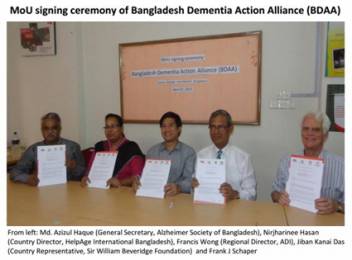
To broaden the scope of work on dementia, HelpAge International in Bangladesh is now involved with work to set up a wider platform; the Bangladesh Dementia Action Alliance.
We have therefore joined forces and signed an agreement with the Alzheimer’s Society of Bangladesh, Sir William Beveridge Foundation, and Alzheimer’s Disease International. As well as setting up the platform, the organisations will lobby policy makers, create a nationwide movement to change the stigma of dementia and improve the quality of care for those affected.
HelpAge’s office in Bangladesh will host the Alliance Secretariat during the initial set up. We will also work together to establish guidelines and a work-plan.
Let’s wish all the best to the four organisations that have come on board to form the Bangladesh Dementia Action Alliance, and also congratulate our country office in Bangladesh for taking up such a noble initiative!
Find out more about our work to support older people in Bangladesh.
Download Ageways 78: Ageing and dementia (5.3mb)